


Blue Sea Systems
Class T fuse 110A-400A 125V DC with 20,000A interrupting rating for lithium battery banks
Class T fuse 110A-400A 125V DC with 20,000A interrupting rating for lithium battery banks
Regular price
€75.48
Regular price
Sale price
€75.48
Unit price
per
Couldn't load pickup availability
- Prices exclude VAT: tax is calculated in the cart based on the delivery country.
- EU businesses: 0% VAT with a VAT number valid in VIES — the field appears at checkout, below the delivery address.
- Reduced 10% VAT on solar and storage for customers in Italy: write to us before ordering.
AVAILABILITY
Product available, quantity not tracked
Shipping
- Italy: €13 on orders up to €150, free shipping over €150.
- European Union: 60 € per order, with no threshold
Rates apply to the cart total and are confirmed at checkout, where shipping to countries outside the EU is also calculated.
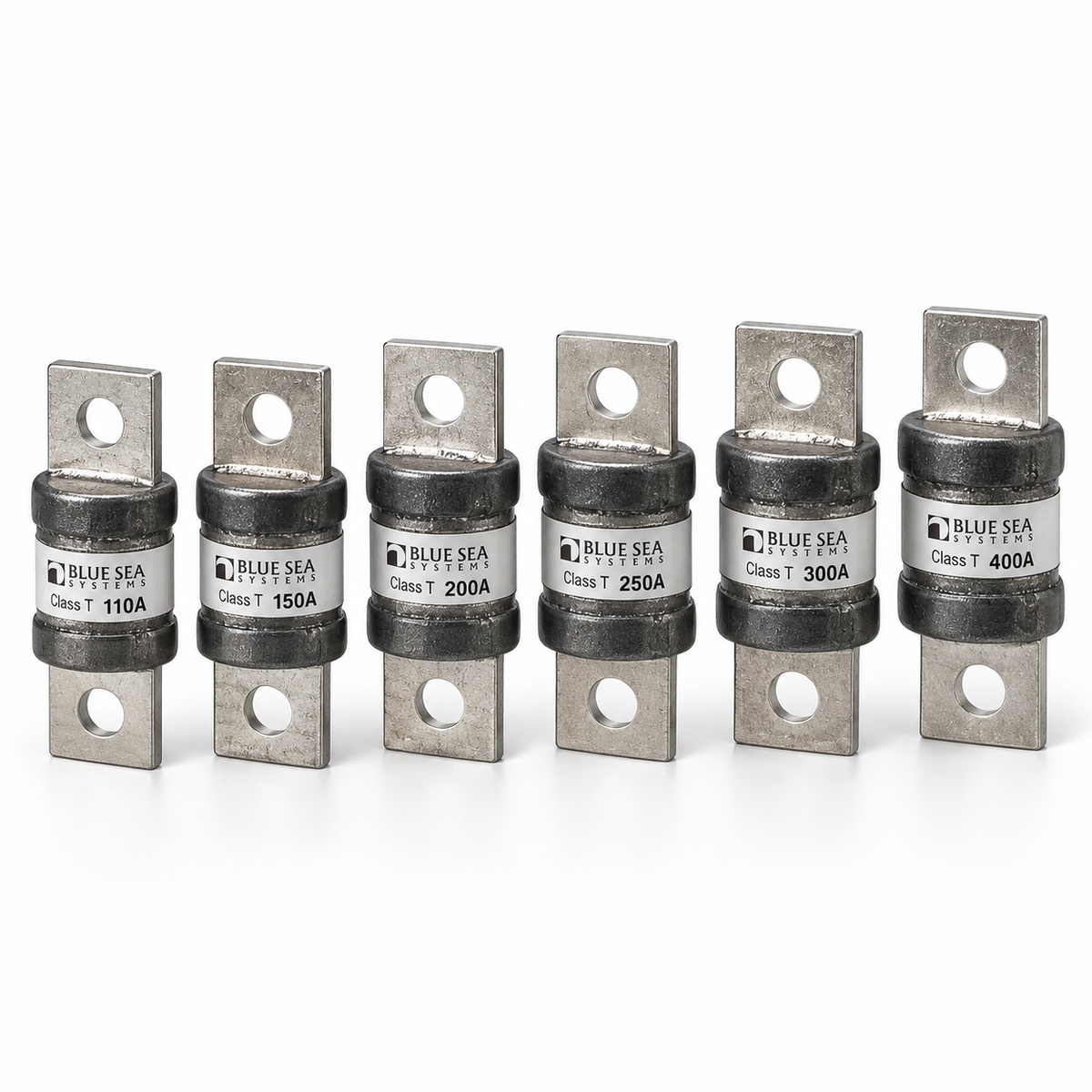
Class T fuse
The fuse the industry reaches for when the source is a lithium bank
125V DC · 20,000A interrupting rating · ten sizes from 110A to 400A
A Class T fuse is a fast-acting, current-limiting fuse rated 125V DC with a 20,000A DC interrupting rating. That last number is the whole point. A LiFePO4 bank at 48V can deliver several thousand amps into a dead short, and in direct current the arc does not extinguish on its own at every zero crossing the way it does in AC. A fuse has to pull it apart by itself. This is why Class T is the standard choice on battery banks in marine work and in professional off-grid, and why a fuse rated only for automotive DC voltages is the wrong tool here.
Two mechanical formats, not interchangeable. The 110-200A sizes have an 8mm hole with 42.86mm centres; the 225-400A sizes have a 10mm hole with 46.7mm centres. A 200A will not fit a holder made for 225-400A, and the reverse is equally true. Only the 225-400A sizes fit the Victron Lynx Class-T Power In. And there is no 160A in this family, whatever you may have been told: the ten sizes are the ones listed below.
Technical data
| DC voltage rating | 125V |
| DC interrupting rating | 20,000A at 125V DC |
| Small format (110-200A) | 8mm hole, 42.86mm centres, 62×27×27mm, about 60g |
| Large format (225-400A) | 10mm hole, 46.7mm centres, 70×33×33mm, 140g |
| Characteristic | fast-acting, current-limiting |
| Sizes | 110A · 125A · 150A · 175A · 200A · 225A · 250A · 300A · 350A · 400A |
Sizing it
Start from the maximum discharge current declared in your battery manual, not from a rule of thumb, and protect each battery individually rather than the whole bank behind one fuse. On a 48V bank of 16kWh racks, 225A or 250A suits a 5kVA inverter and 300-400A a 10kVA one, but the battery data sheet always wins over the inverter rating.
How it mounts
- The fuse bolts between two studs: there is no holder built into it, and none is included.
- For the 225-400A sizes use the Victron Lynx Class-T Power In, which carries two of them on an M10 busbar, or a stand-alone Class T holder.
- For the 110-200A sizes you need the smaller Class T holder. Note its cable studs are M6, which is too small for 50 and 70mm² lugs.
- Torque the fuse bolts to the holder manufacturer's figure and keep the faces clean: a loose joint on a battery feed heats up long before it fails.
MEGA, Class T or NH: which fuse to choose
Three fuse families are actually used on the DC side of a 48V battery system, and they are interchangeable neither mechanically nor in performance.
↔ swipe the table sideways
| Victron MEGA 80V | Class T | NH gPV 1000V DC | |
|---|---|---|---|
| DC voltage rating | 80V | 125V fuse / 160V holder | 1000V |
| DC interrupting rating | not published by the manufacturer | 20,000A | 20kA |
| Connection | direct M8 bolt, 50.8mm hole centres | 3/8" studs (225-400A) or M8 (110-200A) | knife contacts: the cable lands on the base, never on the fuse |
| Where it mounts | already built into the Victron Lynx Distributor, with a status LED per position | Victron Lynx Class-T Power In (2 positions, M10 busbar) or a stand-alone holder | NH fuse base PK0/PK1/PK2/PK3, screw-mounted on the panel |
| When to pick it | residential and light commercial systems built around a Lynx busbar: the most compact and the cheapest | large LiFePO4 banks, where a published DC interrupting rating matters. The reference choice in marine and professional off-grid | industrial switchboards, inspectable isolation, cable up to 240mm² |
Delivery
- Delivered in 10-20 days
- Shipping across Italy and the European Union
- Not sure which size you need? Send us the maximum discharge current from your battery manual and the cable cross-section, and we will tell you