


Italweber
NH gPV fuse link 1000V DC 100A-400A for storage switchboards and PV strings
NH gPV fuse link 1000V DC 100A-400A for storage switchboards and PV strings
Regular price
€171.46
Regular price
Sale price
€171.46
Unit price
per
See the price with VAT
Price including VAT by delivery country
- Italy22% €209.18
- Germany19% €204.03
- France20% €205.75
- Austria20% €205.75
- Belgium21% €207.46
- Bulgaria20% €205.75
- Croatia25% €214.32
- Cyprus19% €204.03
- Czech Republic21% €207.46
- Denmark25% €214.32
- Estonia24% €212.61
- Finland25.5% €215.18
- Greece24% €212.61
- Hungary27% €217.75
- Ireland23% €210.89
- Latvia21% €207.46
- Lithuania21% €207.46
- Luxembourg17% €200.60
- Malta18% €202.32
- Netherlands21% €207.46
- Poland23% €210.89
- Portugal23% €210.89
- Romania21% €207.46
- Slovakia23% €210.89
- Slovenia22% €209.18
- Spain21% €207.46
- Sweden25% €214.32
Shown prices exclude VAT. At checkout the rate of the delivery country applies. Businesses with a valid EU VAT number buy without VAT (reverse charge).
Couldn't load pickup availability
- Prices exclude VAT: tax is calculated in the cart based on the delivery country.
- EU businesses: 0% VAT with a VAT number valid in VIES — the field appears at checkout, below the delivery address.
- Reduced 10% VAT on solar and storage for customers in Italy: write to us before ordering.
Shipping
- Italy: €13 on orders up to €150, free shipping over €150.
- European Union: 60 € per order, with no threshold
Rates apply to the cart total and are confirmed at checkout, where shipping to countries outside the EU is also calculated.
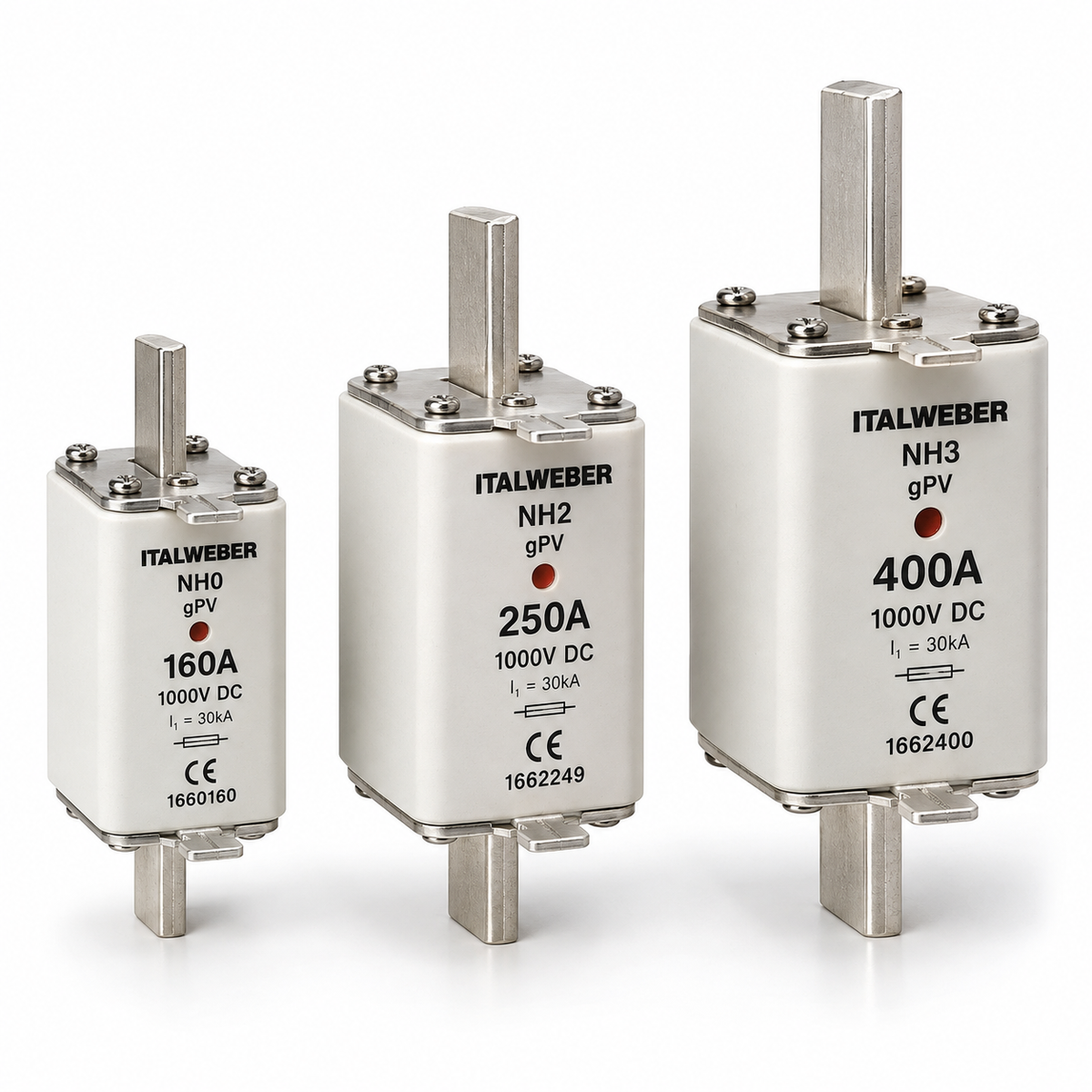
NH gPV fuse link 1000V DC
Switchboard protection, where the job calls for inspectable NH isolation
1000V DC · 20kA breaking capacity · sizes from 100A to 400A
A knife-blade fuse link in NH format for DC circuits, rated 1000V DC with a 20kA breaking capacity. This is what you fit when the switchboard is industrial and the specification asks for an isolating device that can be inspected, replaced on sight, and that accepts cable cross-sections up to 240mm².
Read this before ordering. An NH fuse link has no threaded holes: it has two blades that push into the clips of a fuse base. The cable lands on the base terminals, never on the fuse. So you always need an NH base of the matching size — NH0 goes on PK0, NH1 on PK1, NH2 on PK2, NH3 on PK3 — and the base is not included. For the same reason an NH fuse does not fit a Victron Lynx Distributor or a Lynx Class-T Power In: those modules are built for bolt-down fuses.
Technical data
| Rated voltage | 1000V DC |
| Breaking capacity | 20kA |
| Type | gPV, to IEC 60269-6 |
| Contact | knife blade, for an NH fuse base |
| Sizes | NH0 100A · NH0 125A · NH0 160A · NH2 250A · NH3 160A · NH3 250A · NH3 400A |
| Matching base | NH0 → PK0 160A · NH2 → PK2 400A · NH3 → PK3 630A |
| Manufacturer pack | 3 pieces per size |
| Origin | Slovenia |
gPV and gBat: the honest version
gPV is tested to IEC 60269-6 against photovoltaic sources, which are current-limited and have short time constants. The type tested against battery circuits is gBat, IEC 60269-7, designed for much higher prospective short-circuit currents and longer L/R time constants. On a 51.2V bank a 1000V gPV runs at roughly 5% of its rated voltage, which is a very conservative application, and 20kA is far above anything a 48V bank will deliver. It is not, however, the type formally tested for batteries, and we are not going to dress it up as something it is not. If your specification names gBat, write to us: it is a made-to-order item.
When to choose it
Industrial switchboards, installations where the design calls for NH isolation, where cable goes beyond 120mm², or where the storage panel already sits on steelwork with NH bases for the other ways. For a domestic system built around a Victron Lynx busbar, the right fuse is still the MEGA 80V or the Class T: they cost far less and bolt straight onto the bar.
How it is installed
- Mount the NH base of the matching size on the panel, with its fixing screws.
- Land the power cables with ring lugs on the bolted terminals of the base, at the specified torque.
- Insert the fuse into the clips with an NH handle, with the system isolated.
- The base is single pole: one per way for the positive alone, doubled if the design protects both poles.
MEGA, Class T or NH: which fuse to choose
Three fuse families are actually used on the DC side of a 48V battery system, and they are interchangeable neither mechanically nor in performance.
↔ swipe the table sideways
| Victron MEGA 80V | Class T | NH gPV 1000V DC | |
|---|---|---|---|
| DC voltage rating | 80V | 125V fuse / 160V holder | 1000V |
| DC interrupting rating | not published by the manufacturer | 20,000A | 20kA |
| Connection | direct M8 bolt, 50.8mm hole centres | 3/8" studs (225-400A) or M8 (110-200A) | knife contacts: the cable lands on the base, never on the fuse |
| Where it mounts | already built into the Victron Lynx Distributor, with a status LED per position | Victron Lynx Class-T Power In (2 positions, M10 busbar) or a stand-alone holder | NH fuse base PK0/PK1/PK2/PK3, screw-mounted on the panel |
| When to pick it | residential and light commercial systems built around a Lynx busbar: the most compact and the cheapest | large LiFePO4 banks, where a published DC interrupting rating matters. The reference choice in marine and professional off-grid | industrial switchboards, inspectable isolation, cable up to 240mm² |
Delivery
- Delivered in 10-20 days
- Shipping across Italy and the European Union
- Not sure which size you need? Send us the maximum discharge current from your battery manual and the cable cross-section, and we will tell you