


Milesight
Smart home kit remote site and repeater LoRaWAN Milesight: shelter door, cabinet temperature, leaks, current draw, alarms from the UPS and the generator and remote restart of the equipment
Smart home kit remote site and repeater LoRaWAN Milesight: shelter door, cabinet temperature, leaks, current draw, alarms from the UPS and the generator and remote restart of the equipment
Regular price
€716.39
Regular price
Sale price
€716.39
Unit price
per
Couldn't load pickup availability
- Prices exclude VAT: tax is calculated in the cart based on the delivery country.
- EU businesses: 0% VAT with a VAT number valid in VIES — the field appears at checkout, below the delivery address.
- Reduced 10% VAT on solar and storage for customers in Italy: write to us before ordering.
AVAILABILITY
Product available, quantity not tracked
Shipping
- Italy: €13 on orders up to €150, free shipping over €150.
- European Union: 60 € per order, with no threshold
Rates apply to the cart total and are confirmed at checkout, where shipping to countries outside the EU is also calculated.

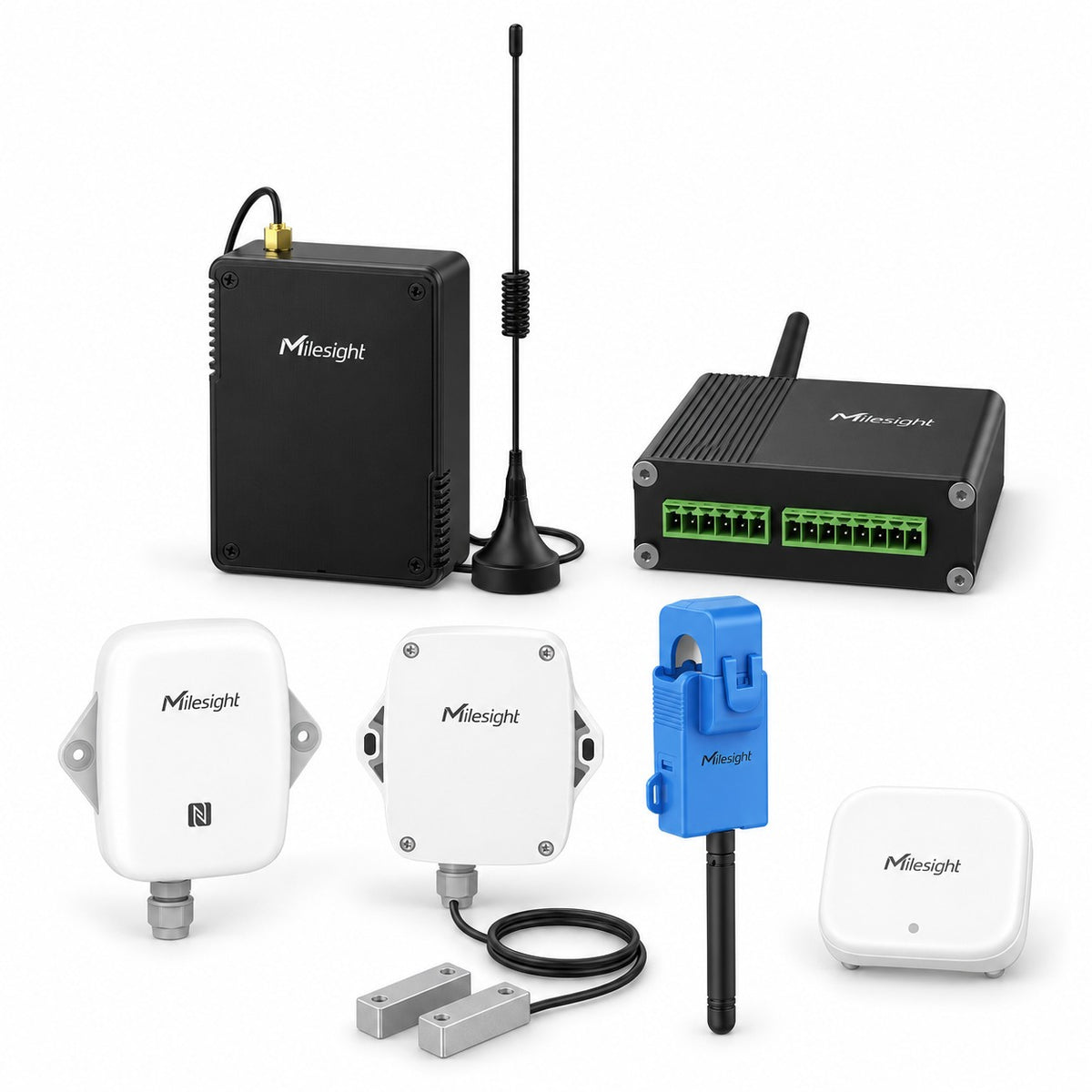
IT kit · remote sites and repeaters
Remote site and repeater kit, 1 site
Opening of the shelter door, temperature and humidity of the room and of the cabinet, water on the floor, current drawn by the site, alarms from the UPS and the generator, and two relays to cut and restore power to the equipment remotely. DIN rail gateway connected to the site backhaul.
Milesight devices
DIN rail gateway
Remote restart of the equipment
Alarms on your smartphone
Customisable kits. This is one of the Milesight LoRaWAN kits in the Smart Home section. For different installations, tailor-made kits or custom automations, write to us from the contact section.
Door and climateContact on the shelter door with the temperature and humidity of the room, plus a sensor inside the equipment cabinet.
Site current drawCurrent on the incoming 230 V line, with a split-core clamp up to 250 A.
2 restart relaysThey cut and restore power to one device or to a group of devices, with the command given from the app.
4 alarm inputsMains failure and low battery from the UPS, generator running, surge arresters, other dry contacts.
What it does
- The magnetic contact on the door reports every opening of the shelter or of the cabin, with an immediate notification, and measures the temperature and humidity of the room.
- A second sensor, inside the equipment cabinet, measures the temperature where it matters: a stopped air conditioner, failed fans and clogged filters show up before the equipment goes into protection.
- The floor leak sensor triggers with 0.5 mm of water: infiltration from the roof or from the cable entries, condensate from the air conditioner.
- The clamp meter reads the current on the incoming line: the site's draw over time, load jumps, a line at zero.
- The controller has two relay outputs and four inputs. With the relays you cut and restore power to a radio, a router or a frozen switch, without going up to the site. The contacts of the UPS and of the generator are brought to the inputs: mains failure, low battery, generator running.
- The DIN rail gateway sits in the cabinet, connects to a port of the site router or switch and sends the data to the cloud. History, charts and notifications are consulted from a smartphone and from a PC.
For several sites to be equipped with the same kit, sites powered in direct current or off-grid, more devices to be restarted separately, the fuel level of the generator tank, if the restart must work even when the backhaul is down and the 4G gateway is needed: tell us the characteristics of your sites from the contact section and we will propose the right configuration together with the quotation.

1DIN rail LoRaWAN gateway in the cabinet, connected to the site router or switch, with the magnetic base antenna taken outside the metal cabinet.
2Magnetic contact with temperature and humidity sensor, on the shelter door.
3Temperature and humidity sensor inside the equipment cabinet, in the upper part.
4Water leak sensor on the floor, with a buzzer.
5Clamp current meter on the incoming 230 V line, in the switchboard.
6Controller with 2 relays and 4 inputs on the DIN rail: it restarts the equipment and reads the contacts of the UPS and of the generator.
How it is installed
Gateway. On a 35 mm DIN rail in the cabinet or in the site switchboard, connected with an Ethernet cable to a free port of the router or of the switch. Power supply via standard 802.3af PoE or USB-C 5 V with the supplied power adapter; it has no terminals for direct current. The magnetic base antenna goes outside the metal cabinet, vertical on a metal surface, high up, clear of obstacles and at least 50 cm from other antennas. IP30, operation from -20 to +60 °C.
Door and temperature. The two parts of the magnetic contact are fastened with screws or double-sided tape on the frame and on the leaf, aligned, at 20-30 mm at most; a 1.5 m cable runs to the transmitter body, fixed to the wall next to the door, which also measures the temperature and humidity of the room. The second sensor goes inside the equipment cabinet, high up, where the air is warmest, fastened with double-sided tape or a cable tie. Both are IP67, from -30 to +70 °C.
Leaks and current draw. Leak sensor resting on the floor, horizontal, at the lowest point or under the cable entries and the air conditioner. Clamp of the current meter in the switchboard, closed around the phase conductor of the incoming line only, never phase and neutral together: 16 mm opening, 250 A rating. It measures alternating current: it does not go on the direct current distribution.
Controller: restart and alarms. On the DIN rail next to the gateway, powered from 5 to 24 V DC. Each relay has a changeover contact and carries 3 A at 30 V DC or 250 V AC: the power supply of the device passes through the normally closed contact, so with the controller off the site stays powered; for larger loads an interface relay is inserted. The four inputs, opto-isolated, read dry contacts or signals from 3 to 24 V DC. Antenna vertical, outside the metal cabinet.
Configuration. The door contact, the temperature sensor and the leak sensor are configured via NFC with a smartphone and the manufacturer's free app. The controller and the current meter are configured from a PC with a USB-C cable and the manufacturer's free software. The gateway is configured from a browser. It is best to prepare everything on the bench and go up to the site with the devices already registered.
Documentation included. Written installation guide with the position of the sensors, wiring diagram of the restart relays and of the inputs from the UPS and the generator, antenna installation and switch-on sequence, and initial configuration of thresholds, names and notifications based on the site indicated when ordering.
What's in the kit

| Qty | Device | What it is for |
|---|---|---|
| 1 | Industrial DIN rail LoRaWAN gateway, Ethernet and Wi-Fi | It collects the data of the sensors and forwards the commands to the controller. Magnetic base antenna supplied. |
| 1 | Magnetic contact with temperature and humidity, IP67 | Door opening and climate of the shelter. |
| 1 | Temperature and humidity sensor, IP67 | Temperature inside the equipment cabinet. |
| 1 | Compact water leak sensor, IP67, with buzzer | Water on the floor, 0.5 mm threshold. |
| 1 | Split-core clamp current meter, 250 A | Site current draw on the 230 V line. |
| 1 | Controller with 2 relay outputs and 4 digital inputs, DIN rail | Remote restart of the equipment and alarms from the UPS and the generator. |
Top quality Milesight devices with the manufacturer's warranty. Batteries included in the three sensors; the gateway and the controller are powered from the site, the current meter from the conductor on which it is fitted or at 5 V via USB-C.
Available connectivity options
- Site network (Ethernet): 1 DIN rail LoRaWAN gateway
- Integrated 4G: 1 DIN rail LoRaWAN gateway with 4G. SIM not included; commands and alarms independent of the backhaul
In the complete kit, the material for the gateway (network cable, pole, PoE injector) changes accordingly. The SIM for the 4G versions is not included.
Choose the version
Devices only
The price updates above when you choose the version, the connectivity and the size.
- The Milesight devices in the table
- Installation guide and initial configuration
- For those who already have a DIN rail, 24 V DC power supply and switchboard material
Recommended
Complete kit with installation material
The price updates above when you choose the version, the connectivity and the size.
- Everything in the basic version
- 24 V DC DIN rail power supply and 2 DIN rails with terminal block
- 2 interface relays 24 V DC with socket, for loads beyond the rating of the controller relays
- 868 MHz antenna with magnetic base and 3 m of cable, to be taken outside the metal cabinet
- 5 m Cat6 network cable, 20 m of shielded signal cable for the inputs, assorted ferrules, stainless steel clamps
- Wall plugs, cable ties, double-sided tape, numbered labels for devices and lines, installation diagram
Before you order
How is the gateway connected to the site?
With an Ethernet cable to a free port of the router or of the switch: it uses the site backhaul to reach the manufacturer's cloud or your server. It is powered via standard 802.3af PoE or at 5 V via USB-C; the 24 V passive PoE of many radio devices is not suitable. As an alternative there is the version with a 4G modem, which requires a data SIM (not included, any operator, traffic below 1 GB per month). It is chosen when ordering.
If the backhaul is down, can I restart the equipment?
With the basic version no: the command reaches the gateway precisely through the backhaul. If you need the kit above all to restart radios and routers when the link is down, choose the 4G version: commands and alarms travel on an independent path. The restart is always a command given by the operator from the app or from their own system.
How does the remote restart work?
Each relay of the controller has a 3 A changeover contact. The power supply of the device, direct current or 230 V, passes through the normally closed contact: from the app you open the relay for a few seconds and close it again. Two relays, therefore two devices or two groups that can be restarted separately. Beyond 3 A, or for a whole power strip, an interface relay or a contactor is used.
The site is powered at 48 V DC, or by panels and batteries: is that all right?
The controller accepts from 5 to 24 V DC, the gateway 5 V via USB-C or 802.3af PoE: from a 48 V distribution a converter is needed, not included. The power supplies of the complete kit are for 230 V sites. The current meter works only on alternating current and is powered from the conductor if at least 3 A flow through it: at small sites, which draw less, it must be powered at 5 V via USB-C. For off-grid sites, write to us from the contact section.
Which alarms can I bring to the inputs?
Any dry contact or signal from 3 to 24 V DC: mains failure and low battery from the UPS contact card, generator running or faulty, tripping of the surge arresters, air conditioner alarm, a second door contact. There are four inputs. UPS, generator and equipment are not included: the kit reads and controls the ones you already have.
I have many sites: how do we proceed?
The kit is designed to be replicated: one kit per site, all on the same platform, with the same names and thresholds. Inside the shelter the distances are a few metres and coverage is not an issue; for DIN rail gateways the manufacturer declares up to 2 km in an urban area and 15 km in open field, so from a site at altitude the same gateway can also receive other LoRaWAN sensors in the area. For supplies across several sites, write to us from the contact section with the number of sites and their characteristics: we will send you the composition and the quotation.
Do they cope with an unconditioned shelter?
The three battery-powered sensors are IP67; the door contact and the temperature sensor work from -30 to +70 °C, the leak sensor from -10 to +60 °C. The gateway and the controller are IP30, from -20 to +60 °C, the current meter IP30 up to +70 °C: they go inside a cabinet or switchboard, sheltered from water and condensation.
Battery life
Door contact and temperature sensor: up to 10 years declared with one reading every 10 minutes at 25 °C. Leak sensor: over 5 years with a button cell. Intense cold and shorter intervals reduce the life. The charge level is visible in the app.
Where is the data consulted and are there any subscription fees?
On the manufacturer's app and portal, from a smartphone and a PC, with charts, thresholds and notifications; no fee for basic use. If there is a network monitoring system or a management software, the gateway can also send the data to that system (MQTT or HTTP): the configuration is included.
Is an electrician needed?
Yes for the part in the switchboard: power supply of the gateway and of the controller, relays in series with the power supply of the equipment, inputs from the UPS and the generator, clamp on the line conductor. It is a job within the reach of the technician who already works on your sites. The three battery-powered sensors are fastened with screws, double-sided tape or cable ties.
What is not included
- Radio equipment, router, switch, UPS, generator and switchboard: they are those of the site
- The data SIM, in the version with a 4G gateway
- Converters for sites powered at 48 V DC or off-grid
- The PC with a USB-C cable to configure the controller and the current meter
- The electrical connections in the switchboard
- In the "devices only" version: power supplies, DIN rails, interface relays, additional antenna, cables and small parts
Shipping
Shipping: free in Italy and throughout the EU. Delivery in 10-20 working days.