


Deye
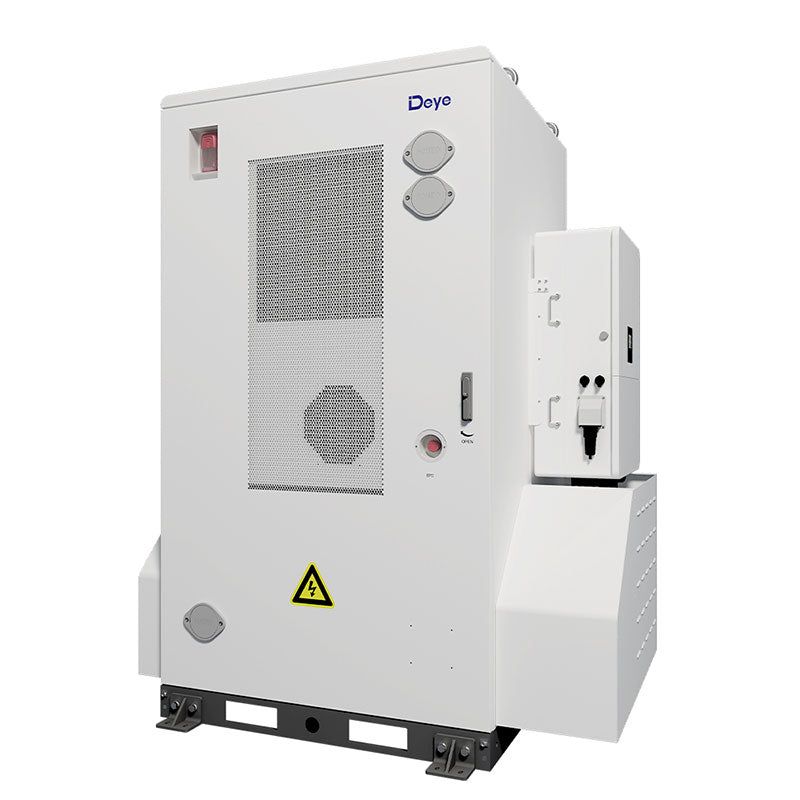
Deye GE-F240-BC-2-A3 Industrial Battery Cabinet LiFePO4 241.15kWh
Deye GE-F240-BC-2-A3 Industrial Battery Cabinet LiFePO4 241.15kWh
Regular price
€41,681.82
Regular price
Sale price
€41,681.82
Unit price
per
Couldn't load pickup availability
- Prices exclude VAT: tax is calculated in the cart based on the delivery country.
- EU businesses: 0% VAT with a VAT number valid in VIES — the field appears at checkout, below the delivery address.
- Reduced 10% VAT on solar and storage for customers in Italy: write to us before ordering.
AVAILABILITY
Product available, quantity not tracked
Shipping
- Italy: €13 on orders up to €150, free shipping over €150.
- European Union: 60 € per order, with no threshold
Rates apply to the cart total and are confirmed at checkout, where shipping to countries outside the EU is also calculated.
Delivery in 10-20 daysC&I storageDeye
Deye GE-F240-BC-2-A3 Industrial Battery Cabinet LiFePO4 241.15kWh
The GE-F240-BC-2-A3 is Deye's outdoor storage cabinet for commercial and industrial applications: 241.15kWh of 314Ah LiFePO4 cells in a single IP55 enclosure, with 15 modules of 16.07kWh in series at 768V. It is designed for peak shaving, time-of-use cost reduction, self-consumption on large PV plants and backup power for warehouses, hotels, farms and fleet charging.
It ships complete with a multi-level BMS, smart air thermal management and a fire suppression system using aerosol, CO detection and a water interface, so it installs outdoors without a dedicated technical room. It pairs with Deye three-phase PCS and inverters from 50, 80, 100, 125 and 150kW and with several cabinets in parallel to scale into the MWh range, communicating over CAN 2.0, Modbus and TCP/IP.
Key features
241.15kWh in one cabinetFifteen 16.07kWh modules with 314Ah LiFePO4 cells, pre-wired and ready to connect to the PCS.
IP55 outdoor installationIP55 protection and operation from -30 to +55 °C: no dedicated technical room required.
Built-in fire safetyAerosol suppression, CO detection, active exhaust and an interface for the water fire connection.
8000+ cycles, 10-year warrantyLiFePO4 cells rated ≥8000 cycles at 0.5P and 70% EOL, backed by a 10-year warranty.
Technical specifications
| Feature | Value |
|---|---|
| Product code | GE-F240-BC-2-A3 |
| Nominal energy | 241.15kWh |
| Nominal capacity | 314Ah |
| Nominal system voltage | 768V DC |
| Operating voltage range | 600–876V DC |
| Cell chemistry | LiFePO4 (LFP) |
| Configuration | 15 modules of 16.07kWh in series |
| Rated DC power | 121kW |
| Max continuous charge/discharge current | 180A |
| Peak discharge current | 285A for 15 s (25 °C) |
| Cycle life | ≥8000 (25±2 °C, 0.5P, 70% EOL) |
| Communication | CAN 2.0, Modbus, TCP/IP |
| Cooling | Smart fan (forced air) cooling |
| Fire suppression | Aerosol, water fire interface, CO detection, active exhaust |
| Ingress protection | IP55 |
| Operating temperature | -30 to +55 °C |
| Humidity | 5–95% RH, non-condensing |
| Dimensions (W×D×H) | 1300 × 1240 × 2400 mm |
| Weight | approx. 2500 kg |
| Certifications | UN38.3, CE, IEC, VDE, RoHS, REACH |
| Warranty | 10 years |
Documentation
PDFBrochure Deye GE-F240 Series & GE-F256Official manufacturer documentPDFManuale utente Deye GE-F240-BC-2-A3Official manufacturer documentInstallation and wiring must be carried out by qualified personnel in accordance with the applicable standards and the electrical design of the system.