


Hager
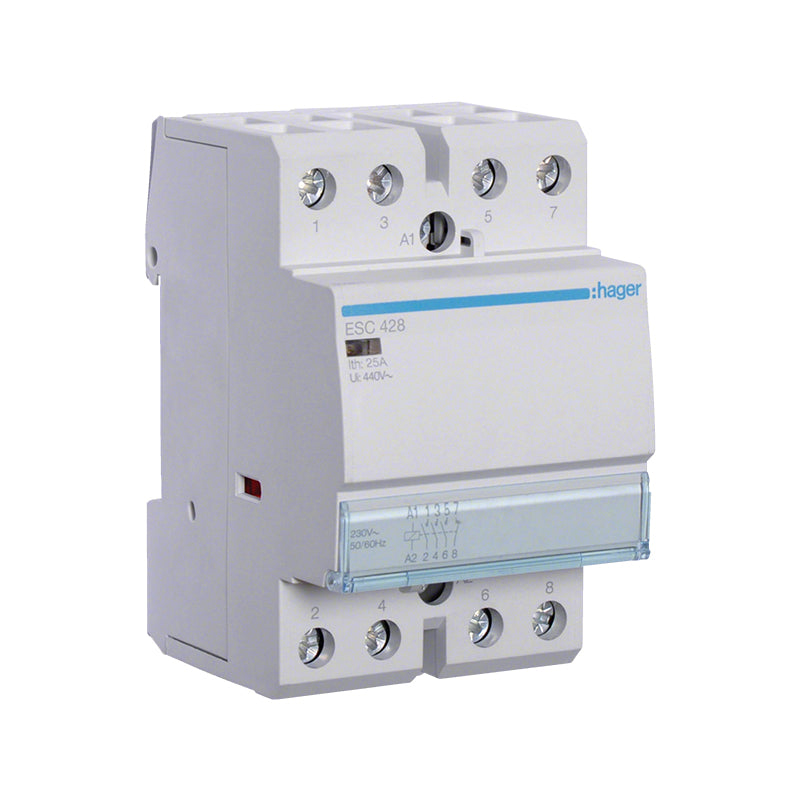
Hager ESC428 Modular Contactor 25A 3NO+1NC 230V Coil
Hager ESC428 Modular Contactor 25A 3NO+1NC 230V Coil
Regular price
€141.46
Regular price
Sale price
€141.46
Unit price
per
Couldn't load pickup availability
- Prices exclude VAT: tax is calculated in the cart based on the delivery country.
- EU businesses: 0% VAT with a VAT number valid in VIES — the field appears at checkout, below the delivery address.
- Reduced 10% VAT on solar and storage for customers in Italy: write to us before ordering.
AVAILABILITY
Product available, quantity not tracked
Shipping
- Italy: €13 on orders up to €150, free shipping over €150.
- European Union: 60 € per order, with no threshold
Rates apply to the cart total and are confirmed at checkout, where shipping to countries outside the EU is also calculated.
Delivery in 10-20 daysProtection deviceAC sideHager
Hager ESC428 Modular Contactor 25A 3NO+1NC 230V Coil
The Hager ESC428 is a modular panel contactor with a rated current of 25A, four contacts in a 3NO+1NC configuration (three normally open and one normally closed) and a 230V AC, 50Hz control coil. It takes up 2 DIN modules.
It is used in distribution boards to remotely switch power loads from a low-current auxiliary signal: stairway and communal area lighting, switched sockets, heating units and heating elements, ventilation, pumps, lamp load circuits. The coil is driven by a switch, a time switch, a twilight relay or a presence detector, while the power contacts open and close the main line. The NC contact makes it possible to implement complementary logic, for example switching an alternative load or handling a status indication. The declared utilisation category is AC-7a/AC-7b, referring to household and similar loads, with an electrical life of 30,000 operations and a mechanical life of 100,000 operations.
Key features
Four contacts 3NO+1NCThree normally open contacts for the load and one normally closed contact for complementary logic or status indications.
25A rated currentSized to switch power circuits up to 25A, in utilisation category AC-7a/AC-7b.
230V remote controlThe 230V AC 50Hz coil is driven by switches, time switches, twilight relays and presence detectors.
2-module width35.75 mm wide on the DIN rail, to fit into consumer units next to the protective devices.
Long service life100,000 mechanical operations and 30,000 electrical operations declared by the manufacturer.
Terminals up to 10 mm²Accepts rigid conductors from 1 to 10 mm² and flexible ones from 1 to 6 mm², with a rated tightening torque of 1.2 Nm.
Technical specifications
| Feature | Value |
|---|---|
| Product code | ESC428 |
| Device type | Modular contactor for switchboards, System M Pro series |
| System side | Alternating current (AC) |
| Nominal current | 25A |
| Utilization category | AC-7a / AC-7b |
| Contact configuration | 3NO + 1NC (4 contacts) |
| Coil voltage | 230V AC |
| Rated frequency | 50Hz |
| Inrush power consumption | 21VA |
| Power dissipation at rated current | 6W |
| Mechanical life | 100,000 operations |
| Electrical life | 30,000 operations |
| Terminal cross-section | 1–10 mm² rigid, 1–6 mm² flexible |
| Tightening torque | 1.2 Nm |
| Number of DIN modules | 2 |
| Mounting | 35 mm DIN rail |
| Dimensions | 60 × 83 × 35.75 mm |
| Weight | 0.22 kg |
Documentation
PDFDatasheet ESC428Official manufacturer documentInstallation and wiring must be carried out by qualified personnel in accordance with the applicable standards and the electrical design of the system.