


Hager
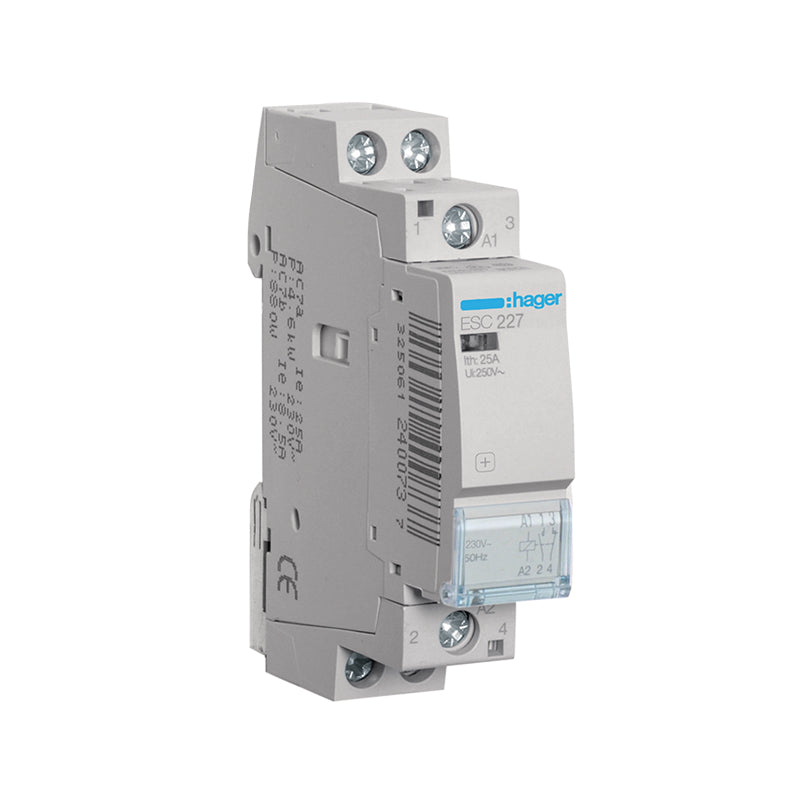
Hager ESC227 Modular Contactor 25A 1NO+1NC 230V AC Coil
Hager ESC227 Modular Contactor 25A 1NO+1NC 230V AC Coil
Regular price
€41.56
Regular price
Sale price
€41.56
Unit price
per
Couldn't load pickup availability
- Prices exclude VAT: tax is calculated in the cart based on the delivery country.
- EU businesses: 0% VAT with a VAT number valid in VIES — the field appears at checkout, below the delivery address.
- Reduced 10% VAT on solar and storage for customers in Italy: write to us before ordering.
AVAILABILITY
Product available, quantity not tracked
Shipping
- Italy: €13 on orders up to €150, free shipping over €150.
- European Union: 60 € per order, with no threshold
Rates apply to the cart total and are confirmed at checkout, where shipping to countries outside the EU is also calculated.
Delivery in 10-20 daysProtection deviceAC sideHager
Hager ESC227 Modular Contactor 25A 1NO+1NC 230V AC Coil
The Hager ESC227 modular contactor is a control device for the DIN rail that makes it possible to open and close an alternating current circuit remotely. It takes up a single module (17.85 mm) and is installed in the distribution board, downstream of the protective devices, where loads have to be driven by a push button, a programmable time switch, a thermostat or an energy management system.
It has two power contacts: one normally open (NO) and one normally closed (NC), with a rated current of 25A in utilisation categories AC-7a and AC-7b (resistive loads and motors for household and similar use). The coil is supplied at 230V AC 50Hz. The NO+NC configuration allows switching logics, for example alternating between two loads or automatically excluding one load when another is activated, a typical function in load management in photovoltaic and storage systems.
Key features
A single DIN moduleJust 17.85 mm wide: it takes up one modular space in the switchboard and leaves room for the other protective devices.
NO + NC contactsOne normally open and one normally closed contact make it possible to control one load and exclude another at the same time.
25A in AC-7a/AC-7bSized for the household and similar loads, both resistive and with a motor, covered by utilisation categories AC-7a and AC-7b.
230V AC controlThe 230V 50Hz coil is driven directly by a push button, a timer, a thermostat or the relay output of an energy management system.
Long life100,000 mechanical operations and 30,000 electrical operations declared by the manufacturer.
Low dissipationTotal power losses of 2.50W at rated current, with limited heating of the switchboard.
Technical specifications
| Feature | Value |
|---|---|
| Product code | ESC227 |
| Product type | Modular contactor for DIN rail |
| System side | AC |
| Nominal current | 25A |
| Utilization category | AC-7a / AC-7b |
| Contact configuration | 1 NO + 1 NC |
| Control voltage (coil) | 230V AC, 50Hz |
| Number of DIN modules | 1 (17,85 mm) |
| Terminal cross-section | 1–6 mm² flexible / 1–10 mm² rigid |
| Power losses | 2.50W |
| Mechanical life | 100,000 operations |
| Electrical life | 30,000 operations |
| Operating temperature | from −10 °C to +50 °C |
| Storage temperature | from −40 °C to +80 °C |
| RoHS compliance | Yes |
| Dimensions | 60 × 83 × 18 mm |
| Weight | 0.12 kg |
Documentation
PDFDatasheet ESC227Official manufacturer documentInstallation and wiring must be carried out by qualified personnel in accordance with the applicable standards and the electrical design of the system.