


Noark
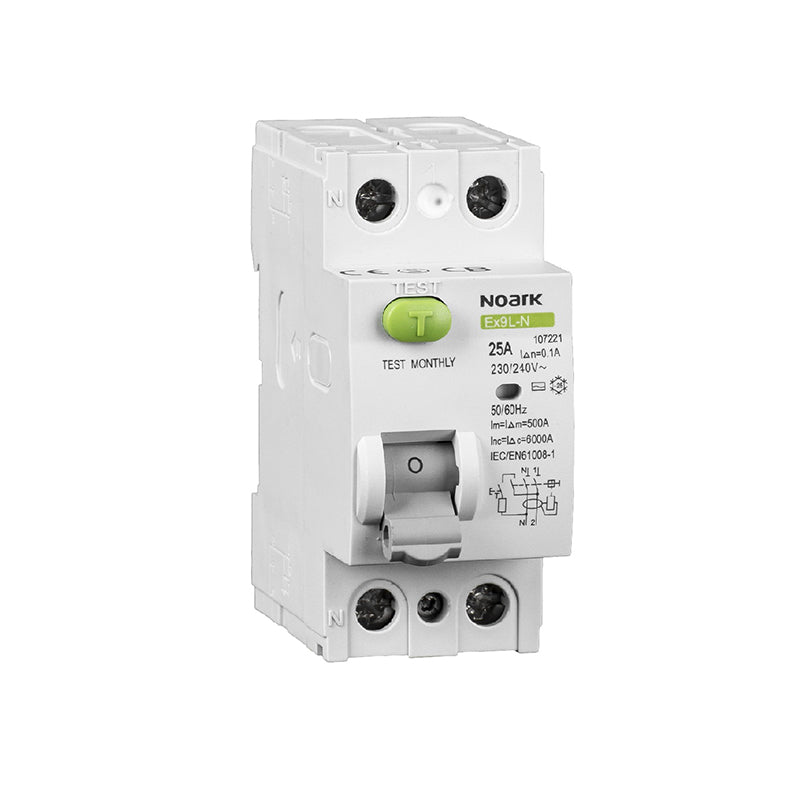
RCCB Noark 108354 Ex9L-N 2P 40 A 100 mA Type A
RCCB Noark 108354 Ex9L-N 2P 40 A 100 mA Type A
Regular price
€45.74
Regular price
Sale price
€45.74
Unit price
per
Couldn't load pickup availability
- Prices exclude VAT: tax is calculated in the cart based on the delivery country.
- EU businesses: 0% VAT with a VAT number valid in VIES — the field appears at checkout, below the delivery address.
- Reduced 10% VAT on solar and storage for customers in Italy: write to us before ordering.
AVAILABILITY
Product available, quantity not tracked
Shipping
- Italy: €13 on orders up to €150, free shipping over €150.
- European Union: 60 € per order, with no threshold
Rates apply to the cart total and are confirmed at checkout, where shipping to countries outside the EU is also calculated.
Delivery in 10-20 daysProtection deviceAC sideNoark
RCCB Noark 108354 Ex9L-N 2P 40 A 100 mA Type A
The Noark 108354 is a residual current circuit breaker (RCCB) from the Ex9L-N range, in a two-pole version with rated current 40 A and rated residual current 100 mA Type A. It takes up 2 modules on the DIN rail and has a rated conditional short-circuit current of 6 kA.
It is installed in single-phase distribution boards as residual current protection upstream of a group of circuits, or as a dedicated residual current device for a line that requires a less sensitive threshold than 30 mA: with 100 mA, nuisance tripping caused by the natural leakage currents of several loads in parallel is limited, while protection against indirect contact and the risk of fire from earth faults is maintained. Type A ensures tripping even in the presence of pulsating unidirectional leakage currents, generated by loads with rectifiers and power electronics. Operation is independent of the mains voltage: the device trips even when the neutral is missing or the voltage is reduced. Being a pure residual current device, it does not protect against overload and short circuit and must always be combined with miniature circuit breakers.
Key features
Two-pole pure RCCBProtection against earth fault currents on single-phase installations, to be combined with the miniature circuit breakers of the individual lines.
100 mA Type A thresholdReduces nuisance tripping compared with 30 mA and also detects the pulsating unidirectional leakage of electronic loads.
Voltage-independent operationThe electromagnetic mechanism trips even when the mains voltage is missing; the voltage is only needed for the test button.
40 A rated currentSuitable for protecting groups of circuits with a total current of up to 40 A.
6 kA short-circuit withstandRated conditional short-circuit current of 6 kA in combination with the required back-up protection.
DIN rail mounting2-module width and 79 mm flush-mounting depth, compatible with standard distribution boards.
Technical specifications
| Feature | Value |
|---|---|
| Product code | 108354 |
| Device type | Modular pure residual current circuit breaker (RCCB), Ex9L-N series |
| System side | Alternating current (AC) |
| Number of poles / phases | 2 poles (single-phase L+N) |
| Nominal current | 40 A |
| Rated residual current | 100 mA (0,1 A) |
| RCD type | Type A |
| Rated voltage (Ue) | 230 V AC |
| Rated frequency | 50 Hz |
| Conditional short-circuit current | 6 kA |
| Miniature circuit breaker (MCB) | Not included (pure RCD, to be combined with MCBs) |
| Number of DIN modules | 2 |
| Flush-mounting depth | 79 mm |
| Power dissipation | 7.2 W |
| Protection rating | IP20 |
| Mounting | 35 mm DIN rail |
| Dimensions | 88 × 36 × 79 mm |
| Weight | 0.22 kg |
| Standards | IEC/EN 61008-1 (residual current devices without integral overcurrent protection) |
Installation and wiring must be carried out by qualified personnel in accordance with the applicable standards and the electrical design of the system.