


Hager
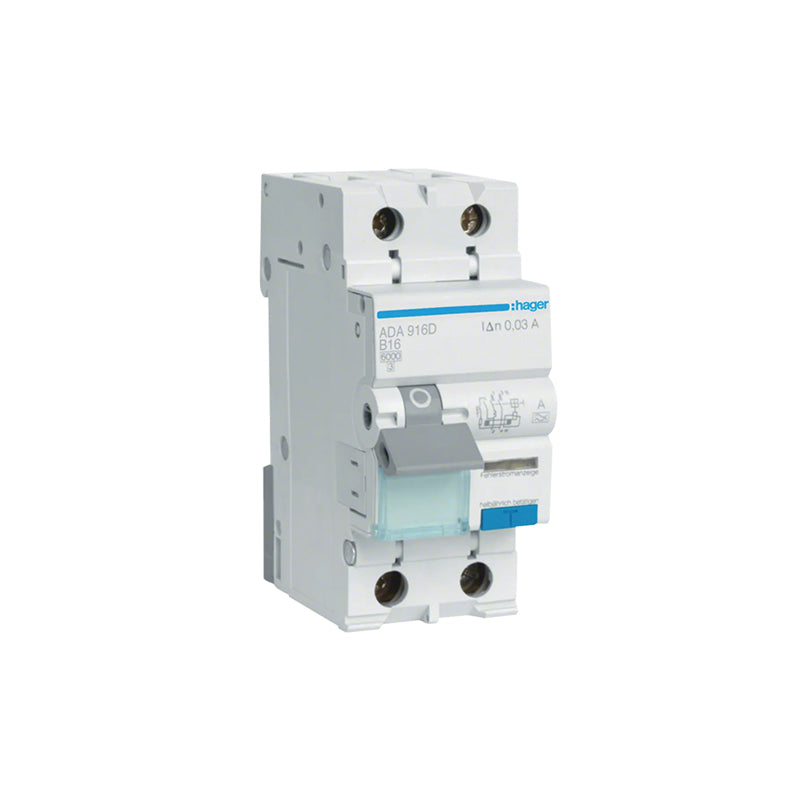
RCBO Hager ADA916D 1P+N 16 A 30 mA Type A
RCBO Hager ADA916D 1P+N 16 A 30 mA Type A
Regular price
€81.11
Regular price
Sale price
€81.11
Unit price
per
Couldn't load pickup availability
- Prices exclude VAT: tax is calculated in the cart based on the delivery country.
- EU businesses: 0% VAT with a VAT number valid in VIES — the field appears at checkout, below the delivery address.
- Reduced 10% VAT on solar and storage for customers in Italy: write to us before ordering.
AVAILABILITY
Product available, quantity not tracked
Shipping
- Italy: €13 on orders up to €150, free shipping over €150.
- European Union: 60 € per order, with no threshold
Rates apply to the cart total and are confirmed at checkout, where shipping to countries outside the EU is also calculated.
Delivery in 10-20 daysProtection deviceAC sideHager
RCBO Hager ADA916D 1P+N 16 A 30 mA Type A
The Hager ADA916D is a DIN rail residual current circuit breaker with overcurrent protection (RCBO) that combines in 2 modules residual current protection and protection against overloads and short circuits. It is configured as 1P+N with only the phase pole protected, rated current 16 A with tripping curve B and residual current sensitivity 30 mA Type A.
It is installed in residential and commercial distribution boards to protect a single final circuit: the high-sensitivity 30 mA residual current protection ensures the protection of people against direct and indirect contact, while curve B (magnetic tripping between 3 and 5 times the rated current) suits circuits with low inrush currents and long lines with low fault currents. Type A detects both alternating leakage currents and pulsating unidirectional ones with a DC component, typical of loads with power electronics. The breaking capacity is 6 kA and the energy limitation class is 3.
Key features
Double protection in 2 modulesCombines residual current and overcurrent protection in a single 35 mm wide device, saving space in the board.
30 mA Type A sensitivityProtects people against direct and indirect contact and also detects pulsating unidirectional leakage currents.
16 A curve BMagnetic tripping between 3 and 5 In makes curve B suitable for final circuits, resistive circuits and installations with low short-circuit currents.
6 kA breaking capacityCompliant with an Icn value of 6 kA, with energy limitation class 3 to contain thermal stress on the cables.
Biconnect terminalsAccepts rigid conductors up to 25 mm² and flexible ones up to 16 mm², compatible with Hager comb busbars.
Selective protection of the individual lineA fault on the protected circuit does not trip the main residual current device, limiting the disruption to the circuit concerned.
Technical specifications
| Feature | Value |
|---|---|
| Product code | ADA916D |
| Device type | Modular residual current breaker with overcurrent protection (RCBO) |
| System side | Alternating current (AC) |
| Number of poles / phases | 1P+N (1 protected pole) |
| Nominal current | 16 A |
| Tripping curve | B |
| Rated residual current | 30 mA |
| RCD type | Type A |
| Breaking capacity (Icn) | 6 kA |
| Rated voltage (Ue) | 240 V AC |
| Insulation voltage (Ui) | 500 V |
| Impulse withstand voltage (Uimp) | 4.000 V |
| Energy limiting class | 3 |
| Number of DIN modules | 2 |
| Terminal cross-section | 1–25 mm² rigid, 1–16 mm² flexible (biconnect terminals) |
| Protection rating | IP2X |
| Operating temperature | From -25 °C to +40 °C |
| Mechanical and electrical life | 2,000 operations |
| Mounting | 35 mm DIN rail |
| Dimensions | 68 × 93 × 35 mm |
| Weight | 0.39 kg |
| Standards | IEC 60898-1, IEC 60664 (data declared by the manufacturer) |
Documentation
PDFDatasheet ADA916DOfficial manufacturer documentInstallation and wiring must be carried out by qualified personnel in accordance with the applicable standards and the electrical design of the system.